NCATS 4DM · small molecules
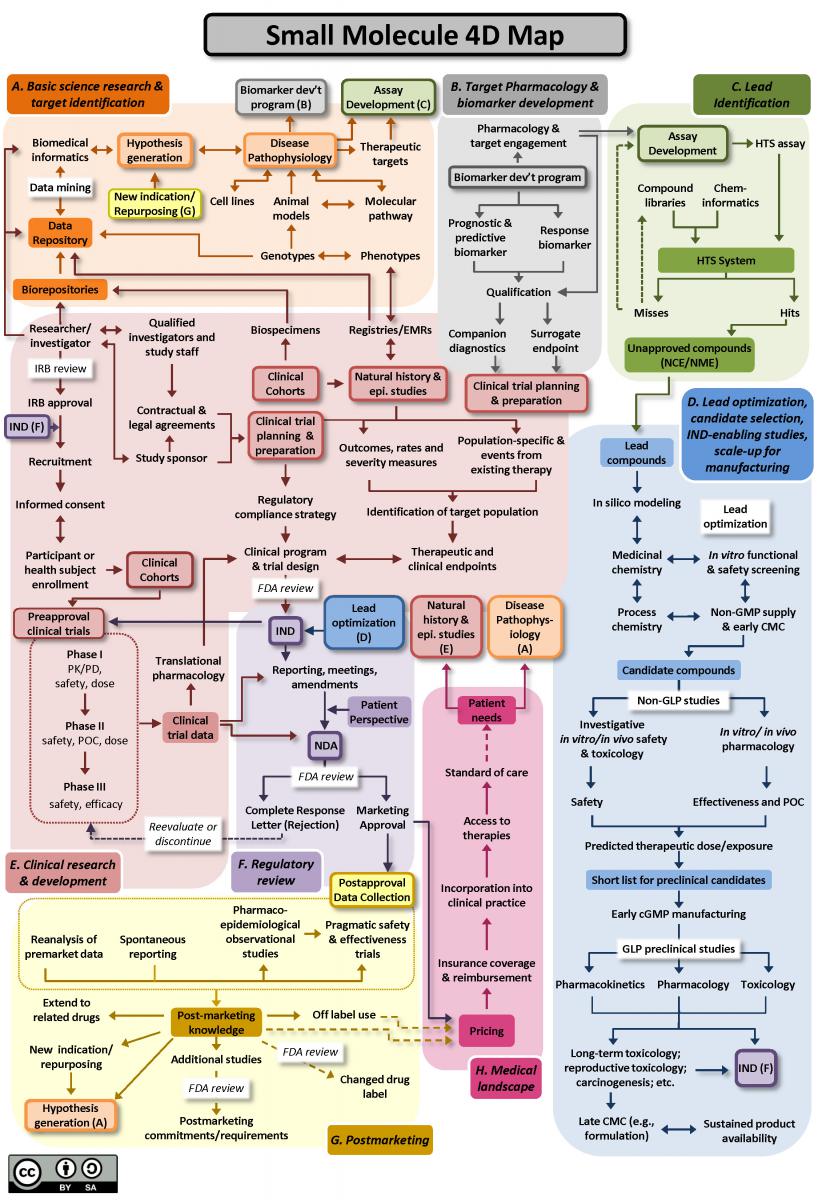
The Drug Discovery, Development and Deployment Map for small-molecule therapeutics. It lays out the modern therapeutic development process as eight connected neighborhoods rather than a straight line, so the dependencies that actually govern a program — and the bottlenecks between them — are visible in one view. Published by NCATS at the NIH and reproduced here under CC BY-SA 4.0.
Six of the eight neighborhoods are common to both 4D Maps. Two are not — and they are the two that decide what a program actually looks like day to day: C, lead identification, and D, lead optimization.
Compound libraries and chem-informatics feed assay development and a high-throughput screening system. The HTS run sorts into hits and misses, and the hits leave the neighborhood as unapproved compounds — new chemical or molecular entities (NCE/NME). No immune system is involved anywhere in this stretch, which is precisely what the biologics route spends the same stage on.
In silico modeling and medicinal chemistry run alongside in vitro functional and safety screening; process chemistry and non-GMP supply carry early CMC. Candidate compounds go through non-GLP investigative safety and toxicology and in vitro / in vivo pharmacology, which together yield a predicted therapeutic dose and exposure and a short list of preclinical candidates. Early cGMP manufacturing and GLP preclinical studies follow — pharmacokinetics, pharmacology, toxicology — and then the long tail the biologics map has no equivalent for: long-term toxicology, reproductive toxicology and carcinogenesis, late CMC such as formulation, and sustained product availability.
The biologics map replaces both neighborhoods wholesale with immunization, library screening, binding maturation and protein engineering. Comparing the two side by side is the fastest way to see why a modality choice is a program-structure choice.
Substantively the same on both maps:
DISCLAIMER: Reference visualization for educational purposes only. Not legal, regulatory, or medical advice. Consult qualified professionals.